Dialysis access serves as the lifeline for patients undergoing hemodialysis. The proper functioning of dialysis fistulas and grafts is essential for effective dialysis treatment. However, over time, dialysis access may experience narrowing, blockage, clotting, or poor blood flow, which can adversely affect dialysis efficiency and overall patient health. To address these issues, minimally invasive treatment options, known as dialysis access interventions, involve advanced vascular procedures designed to restore and maintain dialysis access without the need for major surgery.

Dialysis access interventions are minimally invasive treatment vascular procedures performed to diagnose and address issues related to: AV Fistulas, AV Grafts, and Dialysis Catheters. These vital procedures help maintain adequate blood flow for successful dialysis treatment.
Common Dialysis Access Problems
Patients undergoing dialysis may encounter various issues, including fistula narrowing (stenosis), blocked dialysis fistulas, clotted AV fistulas or grafts, poor dialysis flow, arm swelling, prolonged bleeding after dialysis, dialysis catheter blockages, access site pain, and difficulties during dialysis sessions.
Early treatment is crucial for preventing the complete failure of dialysis access.
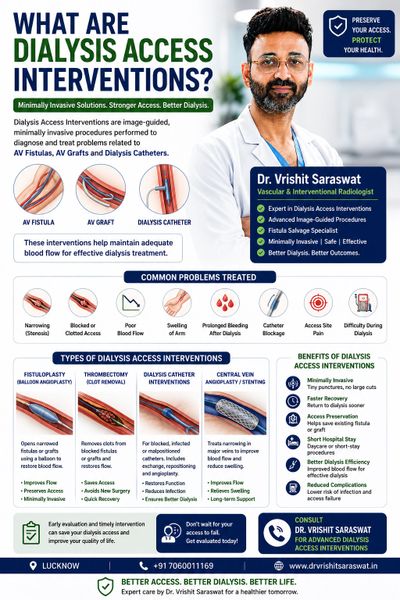
You should consult a specialist if you notice any issues with your dialysis access, such as:
- Reduced dialysis efficiency
- Weak fistula thrill
- Swelling near the access site
- Difficulty inserting dialysis needles
- Increased bleeding after dialysis
- Pain or redness around the access
- Repeated dialysis interruptions
Timely intervention, which may include minimally invasive treatment or other vascular procedures, can help save the dialysis access.
Fistuloplasty (Balloon Angioplasty)
Fistuloplasty is a minimally invasive treatment used to open narrowed dialysis access points, such as fistulas or grafts.
During the procedure:
- A small catheter is inserted into the blood vessel
- A balloon is inflated to widen the narrowed segment
- Blood flow is restored
Benefits:
- Improved dialysis flow
- Preservation of AV fistula
- Minimally invasive treatment
- Faster recovery
- Reduced need for surgery
Thrombectomy for Clotted Fistula
If a dialysis access fistula becomes blocked due to clot formation, thrombectomy procedures can help remove the clot and restore blood flow.
This helps:
- Salvage dialysis access
- Avoid creation of a new fistula
- Continue regular dialysis sessions
Dialysis Catheter Interventions
Procedures are available for:
- Blocked dialysis catheters
- Catheter repositioning
- Catheter exchange
- Catheter-related venous narrowing
These vascular procedures improve dialysis access function and reduce complications.
Central Venous Angioplasty & Stenting
Some dialysis patients develop narrowing of major veins due to long-term catheter use. Advanced angioplasty and stenting procedures help:
- Improve blood flow
- Reduce arm swelling
- Preserve dialysis access
A properly functioning dialysis access is essential for effective dialysis treatment, ensuring adequate blood purification and reducing dialysis complications, which contributes to better long-term health. Regular monitoring of dialysis access is crucial, as it helps detect problems early, allowing for minimally invasive treatment options through advanced vascular procedures.
Procedures are performed through tiny punctures without large surgical cuts.
Most patients recover quickly and resume dialysis soon after treatment.
These procedures help preserve existing fistulas and grafts.
Many interventions are performed as daycare or short-stay procedures.
Restoring blood flow improves dialysis quality and patient outcomes.

Evaluation for dialysis access may include: clinical examination, Doppler ultrasound, fistulography, venography, and blood flow assessment. These vascular procedures utilize imaging to accurately identify narrowing, blockage, or clotting, allowing for effective minimally invasive treatment options.
Dr. Vrishit Saraswat specializes in advanced minimally invasive vascular and interventional radiology procedures using modern image-guided techniques.
We use cookies to analyze website traffic and optimize your website experience. By accepting our use of cookies, your data will be aggregated with all other user data.