Interventional Oncology Treatment in Lucknow
Advanced Minimally Invasive Cancer Care By Dr. Vrishit Saraswat
Interventional Oncology is an advanced subspecialty of interventional radiology that employs image-guided minimally invasive cancer treatment procedures for diagnosing and treating cancer. These tumor ablation procedures are designed to target tumors with precision, minimizing damage to the surrounding healthy tissues. Modern interventional oncology techniques offer effective treatment options for patients with liver tumors, kidney tumors, lung tumors, bone metastasis, and other cancers, particularly for those who may not be candidates for major surgery.

What Is Interventional Oncology?
Interventional oncology, a crucial branch of interventional radiology, involves minimally invasive cancer treatment procedures that utilize advanced imaging techniques such as: Ultrasound, CT Scan, Fluoroscopy, and MRI guidance. These innovative techniques are employed to perform tumor ablation procedures, which aim to: Destroy tumors, Shrink cancer growth, Block blood supply to tumors, Relieve cancer-related pain, and Provide targeted cancer therapy. Remarkably, interventional oncology treatments are often conducted through tiny punctures, eliminating the need for large surgical cuts.
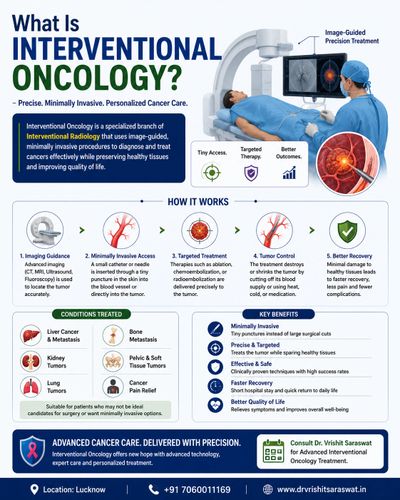
Benefits of Interventional Oncology
Minimally Invasive Treatment
Most procedures are performed through tiny punctures without major surgery.
Faster Recovery
Patients usually recover faster compared to traditional surgery.
Precision Treatment
Image guidance allows accurate targeting of tumors while preserving healthy tissue.
Reduced Pain & Complications
Minimally invasive procedures often result in less pain and lower complication rates.
Short Hospital Stay
Many treatments are performed as daycare or short-stay procedures.
Improved Quality of Life
Interventional oncology helps reduce symptoms and improve patient comfort.
